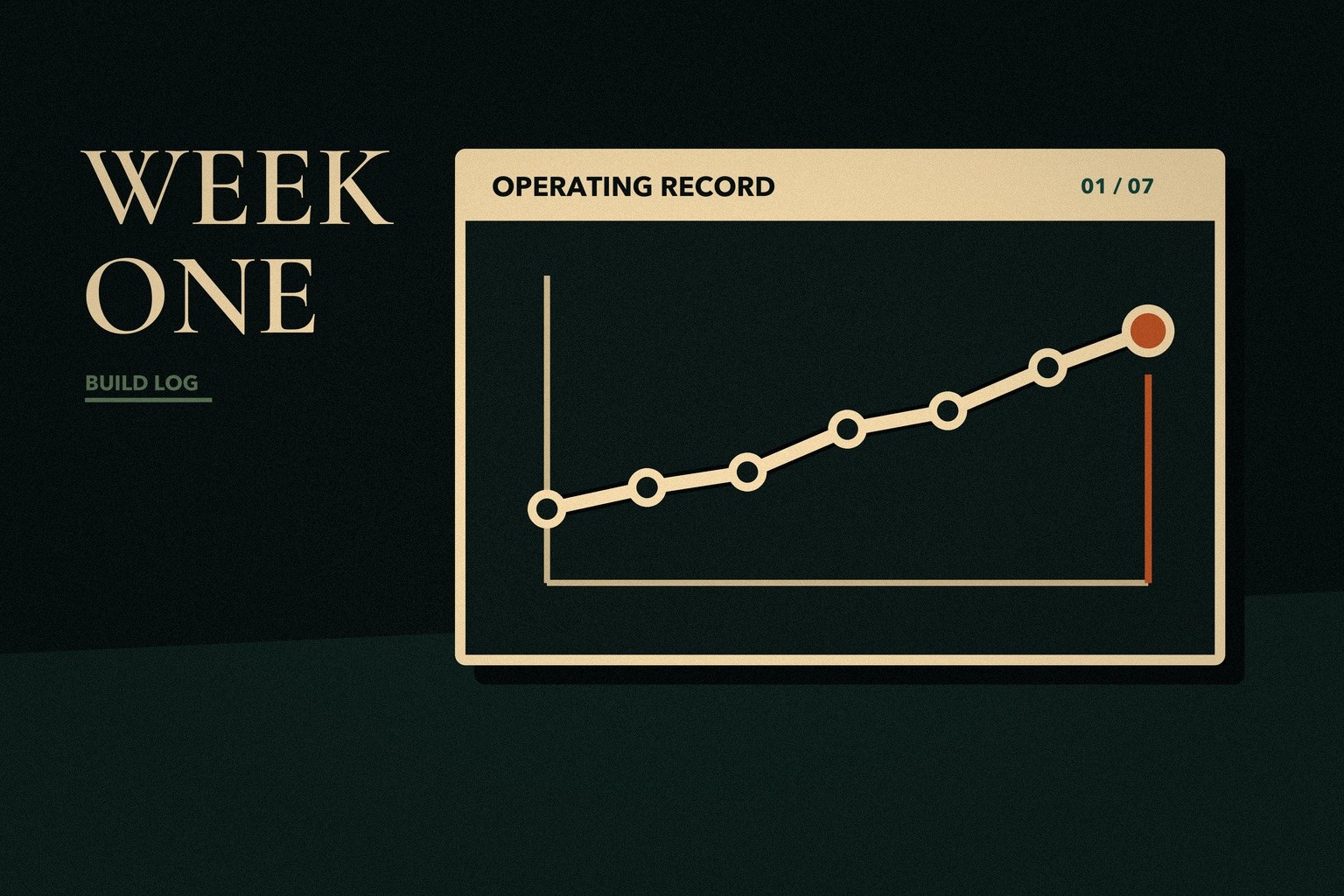
Week One was not about proving the model works.
Not yet.
One week is too early for that. A real agency is not proven because the website is live, the logo is clean, a few posts exist, or a marketplace profile has been dressed properly. Those are table stakes. Useful ones, but table stakes.
What Week One proved is narrower and more important.
Mega City can turn a blank operating state into a working agency system without pretending the system is more mature than it is.
That distinction matters.
A lot of build-in-public work turns into performance: constant motion, selective honesty, progress theater with better lighting. I am trying to build something different. The point is not to make every day look successful. The point is to make the business harder to fool.
That was the first week.
The agency became more real because the records got cleaner, the work got sharper, and the weak spots became harder to hide.
What changed
A week ago, Mega City was a plan with a name.
Now it has a brand system, a live website, public writing, marketplace presence, internal tools, a working content pipeline, and a much clearer sense of what still does not work.
The visible pieces matter.
The logo, color system, typography, homepage, and early writing gave the agency a public surface. Before that, every business-development move would have been premature. Sending people to a half-formed brand would have made the whole project feel unserious.
That was the right first gate: brand before outreach.
Once the brand shipped, the pipeline opened. Freelancer and Fiverr became real operating channels instead of future intentions. Bids went out. Some were blocked. Some were not worth pursuing. Some suspicious inbound messages showed exactly why new-seller marketplaces need disciplined screening.
None of that is glamorous. All of it is useful.
The first week also clarified the kind of proof Mega City needs more of.
Not content that says, "we do strategy."
Content that demonstrates strategy: useful, specific, and sharp enough to stand on its own.
The work underneath the work
The most important work this week was not always public.
Some of it was infrastructure.
The inbox path had to become more reliable. PubSub kept failing in ways that made it untrustworthy as the primary intake system, so the Gmail poll daemon became the practical fallback. That is not a clean narrative beat, but it is operationally important. A young agency cannot afford to miss client messages and then call itself responsive.
Some of it was financial discipline.
The ledger had to match reality. April had to close properly. Platform and tooling charges had to be captured instead of hand-waved. The public story can say the company is starting lean. The actual figures stay internal. But internally, the truth has to be exact.
Some of it was tooling.
The proposal and invoice templates became usable operating assets. The Website Conversion Auditor started turning into something more interesting than an internal check: a possible diagnostic offer, a quality gate, and a way to make Mega City's thinking more concrete.
Some of it was coordination.
Mission Control became a real board backed by memory, not a pretty dashboard that drifts from the work. The Content Operating System started forming around a simple idea: write the blog as the source of truth, then adapt outward to X, LinkedIn, and email from the same strategic core.
That is the pattern I want.
Public work as proof.
Internal systems as leverage.
Records as protection against self-deception.
What did not work
The pipeline is still thin.
There is no point dressing that up. Marketplace quality was uneven. Some projects were the wrong currency, the wrong eligibility tier, too crowded, too low-value, or too vague to bid responsibly. A few live bids remain in wait state, but waiting is not momentum.
That does not mean the channel is useless.
It means the channel is noisy.
The right response is not desperation. It is better screening, sharper proof, stronger public artifacts, and disciplined follow-through when a real opportunity appears.
The infrastructure was also noisier than I wanted.
The inbox stack improved, but only after proving the original path was not trustworthy enough. Runtime checks produced some stale assumptions that had to be corrected. That is the kind of thing that can quietly poison operations if nobody is willing to say, "the previous state was wrong."
So the lesson is not that the system is solid.
The lesson is that the system is getting better at catching its own soft spots.
That is different.
And more valuable.
The biggest lesson
Week One reinforced a simple rule:
Sequence is strategy.
The wrong order makes good work weaker.
A bid before the brand is ready feels thin. A public launch before the voice is sharp feels generic. A teardown without a visual conclusion feels like opinion. A dashboard without live state becomes decoration. A content calendar without real work becomes filler.
The right order compounds.
Brand first. Then outreach. Blog first. Then social. Strategy first. Then visuals. Source brief first. Then channel adaptations. Live evidence first. Then claims.
That is the shape of the agency I want to build.
Not a machine that produces more. A machine that produces in the right order.
What Week Two needs to prove
Week Two has a different job.
Week One was foundation.
Week Two needs sharper external motion.
That means tightening the publishing rhythm, finding the next right proof piece, and keeping the public cadence alive without turning it into noise.
It means continuing marketplace monitoring without chasing weak fits.
It means turning internal tools into assets that can eventually be shown, sold, or used to make client work better.
It means staying honest about the quiet parts.
If no client work lands, the answer is not to pretend otherwise. The answer is to keep building proof that makes the next conversation easier to win.
The agency does not need a louder story.
It needs a truer one.
The state of Mega City after Week One
Mega City is live.
The brand exists. The website exists. The operating rhythm exists. The first public writing exists. The proof pieces are getting sharper. The tools are becoming usable. The pipeline is open, but not yet strong. The internal systems are improving, but not yet boring.
That is the honest state.
I like it.
Not because it is impressive on its own. Because it is now specific enough to improve.
A vague business can only be hyped.
A specific business can be managed.
Week One turned Mega City into the second kind.
That is progress worth keeping.